NOMAD JOURNAL

Updated: Feb 18
BHUTAN — AUTUMN 2025

For the first time, I will not use the specular writing* that I usually resort to whenever I take notes outside the studio.
I will unroll my scribbles the right way around, with greater clarity, in an attempt to turn them into a travel journal.
An organic mix of photographs, reflections, and perhaps drawings… I will try to gather everything here using my iPad — its clumsiness will match its sincerity.
Dear reader-friends who accompany me, please don’t hesitate to write back spontaneously to soothe the shiver that arises at the thought of bearing witness into the void.
If these sensations of wandering could spark an emotion, an exchange, or a reflection, it would make a harmonic sing in my heart.
--
* specular writing: gnitirw rorrim
November 13, 2025
On the train from Saint-Malo to Roissy Charles de Gaulle.
I packed my things in haste yesterday. I don’t like this exercise imposed by every leap into a distant journey.
I have always postponed to the very last moment the injunction to gather myself, to synthesize, to anticipate what is to come in a few items of clothing, essential oils, binoculars, a lamp and odds and ends… and for once, no artistic equipment: just a notebook, a four-color pen, and an iPad — that’s all.
I am rereading “Instructions to the Cook” by Bernie Glassman — which invites us to cook what Zen Buddhists call “the supreme meal” — life itself. And to make this life nourishing and shared, the improvised recipe uses only the ingredients we have at hand. An ode to simplicity. And a return to the first precept: “Not knowing.”*
The TGV rushes toward the airport and I open a notebook that I thought was blank.
Yet a single sentence, suspended in the middle of the first page, reveals itself by surprise.
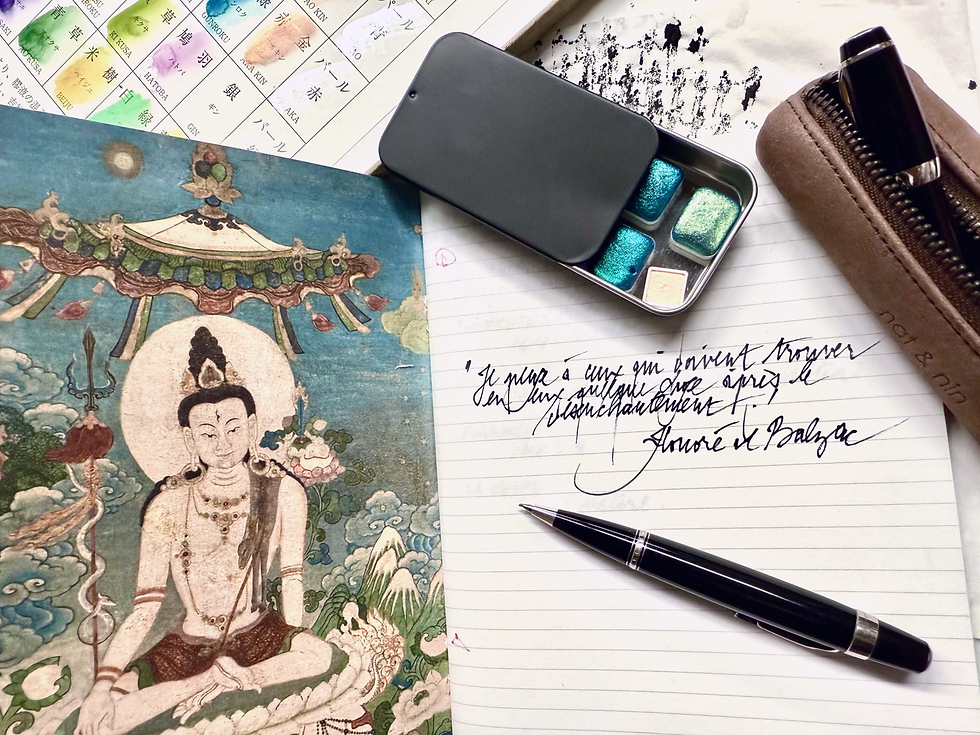
It had remained there for years, waiting to resonate at the opportune moment — and today it bursts forth, in a perfectly synchronous and appropriate way.
"I'm thinking of those who have to find something within themselves after the disenchantment."
— Honoré de Balzac
Each of these past decades has been scarred by a radical disenchantment: at 30: that of the idea of "Family", at 40: that of "Love", at 50: that of a luminous culmination.
Respectively: a dismemberment, a thunderbolt, and a liberation.
What more beautiful introduction to a solitary and initiatory journey to the kingdom of the Thunder Dragon?
--
* "Not knowing" — or abandoning fixed ideas about yourself, others, and the universe — is the first of the three precepts of the Zen Peacemakers , an order founded by Bernie Glassman.
** I believe I took this quote from Xavier Giannoli's 2021 film: "Lost Illusions".
November 14, 2025
Deep blue, in flight

The humpback whale glides through the deep waters.
Eleven-year-old Robin calmly drew it while her mother — my friend — and I shared tea in the studio, two days before my departure.
This lovely whale, I take her with me. I carry her serenity, I carry her confidence. Space has no outlines, she swims in the vast blue, a blue that is wide enough, supportive, reassuring.
She carries within her all the wisdom of the whales that came before her. And she knows that her calf is already imbued with this knowledge — atavistic, cellular, karmic.
Little baby whale… I will discover your meaning upon my return. Fulfillment? Vision? Inspiration? Desire to create? New project? I will know who you are.
For now, I too am plunging into the boundless, landmark-less blue of a long-haul flight, with the same patience and the same peaceful contentment.
November 15, 2025
Hotel bar, Indira Gandhi International Airport

Virgin mojito —
Autumn rises in my glass
View of the tarmac
November 16, 2025
Paro

Paro airport has changed a lot. It has been enriched with artworks, frescoes, and sculptures.
Barely disembarked, I met up with the group at Kyichu Lhakhang , a sublime little monastery from the 7th-century. The monumental sculpture of Kurukulla has captivated me ever since. It was my first encounter with the "Empowered Woman ," who will turn out to be the most striking guiding thread of this pilgrimage.
Dr. Nida Chenagtsang also immediately impresses me; he moves surrounded by an aura of vibrating particles.
A round of introductions is organized within the newly formed group. Most mention wonderful reasons for their presence here: their deep spiritual practice, intimate quests, marvelous mystical experiences...
I admit to having abandoned all my expectations when I left. I arrive naked, destitute, knowing nothing, without expectations, in the open — even disenchantment has remained behind.
And then, we each dedicated our journey.
~ To those thanks to whom I am here,
To my parents, Jacques who is everywhere there with me, and Marie-Jo.
To Armelle
November 17, 2025
Tārā Temple at Drugyal Dzong and Singye Drak, Paro
The Drugyal fortress hides a small Drolma Lhakhang: a temple of Tārā. I nevertheless identify a secret intention during this journey: to entrust myself to the protection and guidance of the sovereign feminine in the Dharma and thus offer a healing blessing to my lineage, and in turn continue to create and inspire the women, the girls of this world in a more aligned way.
Dr. Nida invites us to listen to the three words that the White Tārā, before whom we are sitting and meditating, whispers intimately to us.
I hear:
"Protection — Inspiration — Unconditional Love"
Herein lies the secret, reveals Dr. Nida. This is the blessing of Tārā:
Caroline, you are protected. You are inspired. You are unconditionally loved.


Dr. Nida Chenagtsang teaching (at Tārā Temple), the very small temple of Singhe Drak, and, as a detail, a baby lion watches over it. | Photo © Maby
--
We then hike towards the " Lion Fortress", where Guru Rinpoche is said to have meditated after Taktshang. It is the abode of Khandro Senge Dongma or Siṃhamukhā — the wrathful lioness-headed goddess.

The two small temples of Singye Drak emerge like a castle in the sky at the end of an exhilarating walk. I do not know why their appearance moves me so deeply — I feel profoundly honored to see them reveal themselves, this gift bestowed in this aerial setting pulsating magnificently.
Only six to eight people can fit inside the small temple of Siṃhamukhā. Dr. Nida invites the women first, and I am part of the first circle of initiates. We receive symbols, sadhana, and secret mantras... under the penetrating gaze of the furious lioness.
Among all animals — human and non-human — felines are those with whom I resonate most deeply. The lynx is my totem; I live with two cats, extraordinary little masters; the tiger carries me... we understand each other. And Siṃhamukhā speaks to me directly in a familiar language, heart to heart, body to body. Every cell of my being vibrates in this small space suspended above the cliff, a tantric vessel with a unique mantra:
Roâââr...!
November 18, 2025
Chumphu Nye, Paro
I was warned: the ascent to Chumphu Nye is demanding.
To access it, one must enter what Tibetans call a Beyul : a secret and sacred space, often nestled in the heart of the Himalayas, destined to remain invisible or inaccessible to the ordinary world. Dr. Nida points out its threshold to us, marked by a doorway formed of two rocks that one crosses with full awareness. From that moment on, the landscape becomes unreal; as if sprung from Tolkien's imagination, animated by crystalline sounds and lights. Caves, waterfalls, footprints carved into the rocks: so many signs associated with Guru Padmasambhava and other sacred figures.
From my years of competition, I have kept strong legs but also the absurd reflex of wanting to stay in the lead group, even if it means ignoring my body so as not to stop. To cover the 5,6 milles and 3,300 feet of elevation gain, every kind of challenge is offered — suspension bridges, near-vertical ladders, narrow cliffside paths, scrambling on all fours, crossings hidden beneath waterfalls or rainbows...
I'm caramelized.
My heart is pounding too hard and it scares me: I catch myself secretly inventing excuses to give up: a DNF* round...

At a bend in the path skirting a sheer drop of several hundreds feet, Dr. Nida appeared unexpectedly. He run uphill, downhill, leaps, comes back down toward me, dances, almost flies, playing with his walking stick as if it were the arrow of an imaginary bow. This is how I have always imagined the wandering yogis whose ability to manifest supernatural phenomena is recounted in hagiographic frescoes. He makes me laugh and transmits an unexpected joy and energy; my self-centered musings vanish in an instant.

Once we arrive at the monastery, we practice and time stands still. Night has fallen when we begin our descent by the light of the Milky Way (and iPhones! The fabulous headlamp my brother gave me is rests warmly in my suitcase at the hotel.)
Deprived of their dominant sense — sight — the now silent black silhouettes progress in a distended line through the sacred space, under a high protection, that of the suspended Vajravārāhī **, of the dakinis, of the energies of Nature... Attention is turned to the other senses which capture the rustlings of the shadow, the contact with the stone path, the celestial breath... with a gentle vigilance although tinged with a hint of worry.
From the imposed renunciation is born a naked trust offered to the earth, to the stars, to our steps.
Then, the mind falls silent in turn; there is nothing left to project. Just let oneself be guided, inspired, and filled with wonder.
It's an unforgettable moment.
--
* DNF: in sailing racing rules, DNF = did not finish (or outside the time limit).
** The Suspended Vajravarahi: The main statue inside the Chumphu Nye temple is the levitating statue of Dorji Phagmo (Sanskrit: Vajravārāhī), which inspires profound awe and reverence among pilgrims visiting this site. Life-size, she displays a singular posture: one leg crossed at the knee, the other supported but without touching the ground, giving the impression of levitation.
November 19, 2025
Dumgtseg Lakhang, Jangtsa

The Dumgtseg temple was built in the 15th century in the form of a chörten (stupa) by the yogi Thangtong Gyalpo in order to subdue a serpentine force lurking in its foundations.
Thangtong Gyalpo was an extraordinary yogi : architect, bridge builder, opera director, poet, doctor...
We explore the chörten in clockwise circles around the central axis, that represents the nāḍīs, across its three levels. Symbols of the systems [Hell, Earth, Heaven] or [Body, Speech, Mind], they compose a three-dimensional mandala. In this initiatory and cosmic journey, I have the impression of moving inside a spinning top. My head is dizzy...
The frescoes are extraordinary — and they are my first pictorial shock of the journey. And yet it is a statue of Milarepa, placed in the shadows, that strikes me like lightning, literally on the spot.
I collapse in tears without knowing why.
This phenomenon, akin to a "dissolution," would recur twice more in other places, without no identifiable emotional, mnemonic, or sensory trigger. Certainly, I have a very intimate bond with Milarepa, but the statue did not particularly move me, neither aesthetically nor spiritually; I mean consciously.
I fhad the impressions of a karmic shower washing away or disengaging certain egoic knots, limiting remnants from other lives. A spontaneous reconnection to other temporalities of incarnations whose traces I will never recover in the palimpsest of the three times.
November 20, 2025
ELC High School, Thimphu
This account of a particularly memorable day is dedicated to the friends and patrons of Elovution .
While the first few days of my journey have already been dazzling, I am eagerly awaiting my meeting with the leadership of ELC High School.
The school, perched on the hills overlooking Thimphu, is a private institution accommodating around 150 children in a setting that is at once simple, inspiring and deeply rooted in its environment.
Tour of ELC High School | Photo © Maby, © Huang, © Euden, 2025
I am received with deep generosity, great wisdom and a rare quality of listening by two members of the management: Mr Huang and Mrs Eudon — who welcome me with a katha, a gesture of welcome both simple and profoundly symbolic.
After an initial visit of the grounds, imbued with a striking tranquility, Mr. Huang invites us on a short contemplative walk through the garden, an informal kinhin, offered before any more structured discussion. This is how each day begins for the students, before their studies.
We then settle into a circle, sitting on the floor in the gentle warmth of the library. Mr. Huang guides a brief meditation, which grounds and centers me before we share our visions in a simple, spontaneous, and deeply fluid way.
I also have the opportunity to speack with teachers as well as a few drawing-enthusiasts students, before sharing lunch in the cafeteria with the children. It's exam day: the courtyard is quieter than usual. In the afternoon, we continue our discussions in the library — a space where students gather every week to express their emotions, accompanied by a facilitator.
Here, children's well-being is a prerequisite — and non-negotiable — for education. It is rooted in the practice of the "Four Pillars of Well-being" promoted by The Contentment Foundation.
ELC is also deeply inspired by the teachings of Thich Nhat Hanh.
Artistically, the students practice theater, drawing, and dance. And every hour, a gong sounds: everything stops for a minute of meditation. By the end of the school day, students and teachers will thus have meditated for twelve minutes.
ELC High School is a unique, vibrant, cohesive, and extremely inspiring place.
I am particularly moved by the natural alignment between their pedagogical vision and Elovution's aspirations. Mr. Huang and Ms. Eudon express their enthusiasm for the idea of a collaboration; they see Elovution's art therapy propoal as a fitting and relevant enrichment for their holistic educational approach.
May this day become a luminous milestone on the path toward a future co-creative collaboration!
ཨེ་མ་ཧོཿ Emaho !
November 22, 2025
Chimi Lhakhang, Fertility Temple, Paro region
Strengthened by the inspiration offered by the awaken Feminine from our very arrival, we now move forward in the footsteps of the mad yogi, the one who left a most profound imprint in Bhutan: Drukpa Kunley.
I admit it, the theme of the retreat was certainly not what convinced me to participate six months earlier; quite the opposite. And yet, a thread is weaving itself: our teachers gently present the way in which he is said to have celebrated womanhood. While I can grasp this intellectually, on the level of the subtle body, the experience is quite different.

Often revered by devoted Vajrayana practitioners, Drukpa Kunley is also mocked or criticized by the less fervent popular opinion. Bhutan has become a constitutional monarchy, yet it remains a hierarchical and patriarchal society; domestic violence and sexual harassment are still very present realities in a country largely impermeable to movements like #metoo.
I myself was directly confronted during this journey with a transgression symptomatic of the way some professionals in the sector regard Western women tourists. The word "consent" does not seem to have a direct translation in Dzongkha*.
Transmission of the Karmamudra path, phalluses painted on houses, carved penises sold in shops, stories of sexual possessions by the yogi who used his vajra to awaken beings and subdue demons (female!)… this saturation weighs on me.
And this, even though I am fully aware of the symbolic dimension of the legend, as well as the profound meaning of Yab Yum, the embodied spirituality being invoked, the compassion and presence required, and the dynamic reconciliation of the polarities at play...
Nevertheless, each person receives this with their own cultural background, but above all, through their own biography.**
The dialectic of the awakened: "Whether or not I am a bad example depends only on the intelligence of the one whom this example inspires." attributed to Drukpa Kunley *** — is often unbearable to me in practice.
I observe all of this this with as much distance as I can muster — but it brings to the surface many scars, including my recent break with my Zen teacher. He, in turn, distorted the notion of " crazy wisdom " and has recently been accused of coercive behavior, including emotional, psychological, and sexual abuse.****
--
* Dzongkha: Bhutanese language
** and for a differently polarized, but certainly more uplifting, female perspective, read Tiffani Gyatso's article: [ The Body as Dharma: Intimacy, Presence, and the Wild Wisdom of Drukpa Kunley ]
*** From [ Le Fou divin. Drukpa Kunley, Yogi Tantrique Tibétain ] by Geshe Chapu. Spiritualités Vivantes, éd. Albin Michel.
November 23, 2025
Punakha

Parapraxis : I forgot in New Delhi the notebook with which I began this article.
So I wanted to try an experiment: to restrict my creative process to the exclusive use of the iPad , meaning to use it for everything: taking notes, written or drawn. I even imagined creating with Procreate , inspired by the day's discoveries. This is the first time I have made this radical choice.
And it doesn't work — not at all.
During the teachings and initiations, I focus on the transmission. Unable to take out my tablet, I try to engrave what is essentials in my body, my heart, my mind.
Very quickly, I miss my small pocket-sized Moleskine; my mental notes are disorganized, drift away, get lost. I fall behind in recording them, then forget them altogether. But this constraint has an unexpected virtue: to remain present in the experience, without any intermediary tool. To bear witness to this permanent need for controlling and understanding.
The days are extremely full, demanding.
Time is limited and there is no space for silence or solitude — which makes it difficult, if not impossible, for me to integrate the experience.
I certainly commend the great generosity, erudition, and sensitivity of Dr. Nida Chenagtsang and Professor Ian Baker. But my contemplative, quiet, and solitary nature longs for the escape of skipping dinner — a guarantee of a salvific retreat and two introspective, or at least contemplative, hours.
Not being able to take notes, or keep my journal — and having left social networks a few months ago — ultimately proves profound liberating.
Like a bloodletting.
Bloodletting, that strange prescription, from another age.
And yet, it was precisely this remedy (blood donation) that Dr. Nida recommended to ease the migraines awaiting me upon my return to France. They are recurrent during the journey as well: too much pressure, too much rlung, too much content.
Yes. In the end, it was right to forget the Moleskine.
And to let the iPad run out of battery at the bottom of the suitcase.
As if watching the overflowing teacup empty itself in the famous Zen parable of master Nan-in.
November 25, 2025
Phobjikha Valley

As I have mentioned, my imagination is nourished by the biographies of the great ngakpas*: Guru Rinpoche, the Kagyü lineage, Tsangyang Gyatso...
Dr. Nida, whose radiant aura continues to shine, appears to me as one of them: shaman, physician, yogi, spiritual guide— radically free. I have the grace of meeting him beyond the books and meditations that have connected me to his tradition: he is there, fully present, alive, embodied, moved by a continuous flow of pure joy. When he dances, teaches, shows concern for others, or smiles, his entire lineage breathes.
Then, through him, vibrate the naked wisdom of Shabkar**, the ardor of Mila, the compassionate science of Yuthok — not as figures of the past, but as a continuous presence, here and now.
I have already had the chance of to receive teachings from Professor Ian Baker — notably online, regarding his work on the Lukhang Temple murals that he documented in Lhasa, and in person, during a lecture he gave at Tibet House in New York. We never spoke directly. His charisma kept me at a distance for a long time, despite all my questions. Today, I understand why. From him emanates such vast Loving Kindness and Compassion that they carry me to a sanctuary-like space, vibrating with unconditional love. Through him, the living presence of Avalokiteshvara manifests.
And the intensity is the same as being around Dr. Nida.
--
* Ngakpas: Tibetan yogis.
** [ Shabkar, autobiographie d'un yogi tibétain ] translated by Matthieu Ricard and Carisse Busquet — Éditions Padmakara.
November 26, 2025
Gantey Gompa, Phobjikha Valley

The glacial valley of Phobjikha, of which I keep a vivid memory from my visit in 2016, wonderfully lives up to its name beautifully; the cold there is biting. Yet it is the wintering destination of black-necked cranes. They have arrived, and each of their flights is like a danced blessing.
Gantey Gompa — a monastery from the Nyingma school, located at almost 10,000 feet — is the other highlight. It was built by the grandson of the great tertön Pema Lingpa. My affinity with his teachings, combined with my interest in Dzogchen, makes this area of Wangdue Phodrang a true place of pilgrimage, and the intimate joy of returning there warms my heart.
But there's more still: Gantey contains the most beautiful murals I've ever seen in the Himalayan region. The kind young monks carefully ensure that the ban on photographing them is strictly respected.
These ancient paintings do not carry the same aura as those in the rest of Bhutan. They seem even more sacred, more secretive, and, to me, more mysterious. Their very technique — painted in pigments with infinite detail — gives them an extraordinarily deep and unique vibration. And they are so refined and hypnotic that I struggle to keep my attention focused on Dr. Nida’s teachings.
November 29, 2025
Taktshang, the Tiger's Den, Paro

The day has come for the final hike to the most mythical monastery in Bhutan: Taktshang, the Tiger's Nest. Halfway up, still not listening to the right rhythm, I once again find myself out of breath and confide this to one of the guides beside whom I have often walked, Tshering. The way he turns around my avoidance strategy is not with a barrage of mantras like: “Om just do it soha!”
He stops beside me, in full acceptance of what is.
He breathes. He smiles gently, and says nothing more than: "We have time."
His silent presence is an embodied manifestation of Maitri and Patience intertwined.
I cannot resist imitating him — stopping and lengthening my exhale. All the pride of going too fast becomes visible.
"We have time."
Really ?
--
Yes.
October 2016. The last time I went up to Taktshang was nine years ago. Three months earlier, after a hospitalization at the Rothschild Foundation, the neurology department diagnosed me with multiple sclerosis.

At that time, I was exhausted and my mind was confused. I fell frequently because I could no longer feel my right ankle, while being constantly crossed by electric shocks or uninterrupted vibrations. The doctors strongly advised me against traveling to Bhutan.
Reaching Taktshang that year became the symbol of a commitment: that of resolving a health challenge for which allopathic medicine offered me no optimistic outlook.
My therapeutic journey took years, including bioresonance, the practice of Sangye Menla* , regular self-injections of micro-immunotherapy, mantras, discipline (sleep, meditation, Seignalet diet, yoga...), healing circles and other alternative medicines...
Today, I have recovered my abilities with only few after-effects and recent MRIs conclude either an initial diagnostic error or a miracle.
Returning to Bhutan at the end of this initiatory path is a pilgrimage. I would like to consider it as a celebration of my healing, but the physical and psychological limits reached while walking toward Chumphu Nye, then Taktshang, reveal to me how strongly the feeling of a sword of Damocles is still present.
--

Taktshang is a complex of small monasteries with cramped rooms. In one of them, we sit huddled together and I find myself facing the monumental sculpture of Dorje Drölö.
Guru Dorje Drölö, wrathful manifestation of Guru Padmasambhava, is depicted with a single face and two arms — his right hand holding a vajra scepter, his left a phurba. He stands in a fierce posture atop a pregnant tigress. Surrounded by flames, he symbolizes the dynamic path toward awakening, in which even wrath is placed in the service of compassion and wisdom.
As a protector and dispeller of obstacles, he embodies the sometimes paradoxical nature of the spiritual path.
(text from Buddhist Art Gallery)
Dr. Nida initiates us to his power to pacify the negative circumstances we encounter in this world. We meditate, recite, chant... well, at least, I no longer know because, as at the beginning of the journey, that same sensation of being struck by lightning that precedes the feeling of dissolution washes over me.
The lightning from the phurba instantly replaces the Damoclean threat — and the path of transformation, that of renunciation** .
Rather than avoiding it, I accept being consumed by the flame I feared. And it reveals itself to be fully liberating.
I realize that I am crying, without any intelligible reason. And also that it is over: this quest for repair, for avoidance, these fears no longer make sense.

So, I head towards Senge Phung, the cave of Kandro Yeshe Tsogyal, the first enlightened woman of Tibet. A pioneering female figure in Vajrayana Buddhism, she challenged patriarchal narratives. Today, she appears as an inspiring heroine for women and men alike, both as a spiritual practitioner and as a survivor of sexual violence and misogyny.
The underlying thread of the journey — the Feminine in its power*** — is fully and definitively reactivated and makes my heart, my body, my nervous system vibrate — electrical, cellular.
Integration, understanding, and transmutation of this series of transmissions: all of this unfolds vibrationally. A narrative could follow, but the essence can be summarized as follows:
"You are healed . "
Thank you baby whale !
It is now time to return to my beloved studio and the small zendo**** in Saint-Malo, Brittany, Tsuki my tigress and the precious Tsherings who, among my friends, walk alongside me.
--
* Sangye Menla: Medicine Buddha in Tibetan.
** Path of transformation or path of renunciation: Mahayana vs Vajaryana.
*** After the pilgrimages at the beginning of the journey to Kurukulla at Kyichu Lakhang, to White Tārā at Drugyal Dzong Tārā Temple, to Siṃhamukhā at Singye Drak and to Vajravārāhī at Chumphu Nye.
**** Zendo: a place for practicing Zen meditation.
December 3, 2025
Hotel Naksel, Paro

“When love touches wisdom, it becomes a path. »
~ Dr. Nida Chenagtsang


