FIVE BUDDHA FAMILIES II


The five colors of the prayer flags, seen snapping in the wind on Himalayan passes and as far as my garden in Brittany, are no mere detail.
They order a complete cosmology, one that embraces both the sacred world of awakened mind and the neurotic world of ego-centered existence.

I am continuing my series inspired by the Tibetan tradition of the five Buddha families. Each family holds together a color, an element, many symbols, and above all a psychological disposition. With them I have associated the ecological concerns that run through me, particularly those regarding biodiversity and the living world.
After PADMA / fire and VAJRA / water (see https://www.carolinemaby.art/en/post/five-buddha-families ), here are KARMA / air and RATNA / earth.
THE FIVE FAMILIES: RESEARCH AND INTENTION
Each family can be read in two registers. Under the rule of ego, it produces a neurotic passion, which depending on the family is pride, anger, passion, jealousy, or ignorance. Through the lens of awakening, the same energy unfolds as a wisdom in which the neurosis is transmuted: equanimity, mirrorlike clarity, discriminating awareness, accomplished action, space.
These families describe five ways in which energy is distributed and dances within us and around us, depending on whether it crystallizes around a center or circulates in harmony. Each of us carries all five.
Chögyam Trungpa Rinpoche transmitted this mandala to Western practitioners in the 1970s, with the idea that it could be used to read or explore a quality of being, an emotional climate, a relationship. Bernie Glassman later made it, within the Zen Peacemakers, a tool for work in the field, particularly in social action, to look at a situation, a conflict, or an organization, and to identify which of the five energies dominates it and in what state of freedom or confusion.
This is the perspective that interests me, because it allows the mandala to be carried off the cushion and used as a tool of awakening in the service of engaged and attuned action. So I chose to take up this paradigm to speak about ecology.
For a long time my painting has been inspired by water, light, and the living world. I wanted to bring my ecological concern and my sitting practice (Zen) together in a single vision, without either becoming a literal illustration of the other.
The mandala of the five families opened a path of expression for me because it works in both directions. It is at once a cosmology, which divides the world into five elements directly connected to Nature, and a psychology, which divides the mind into five passions. It therefore makes it possible to show and paint, in a single movement, a state of matter and the state of mind that endangers it.
Seen this way, the ecological crisis appears as the form an energy takes when it is in the grip of an ego, individual or collective, that needs to reassure itself that it is solid. Its source lies in the mind before it lies in technology.
The summer that has just ended made this grid painfully legible: soil and houses crack, fields become barren, forests burn, thawing permafrost brings humanitarian disasters, water is rationed, and all of it accelerates in a seemingly "unexpected" way.
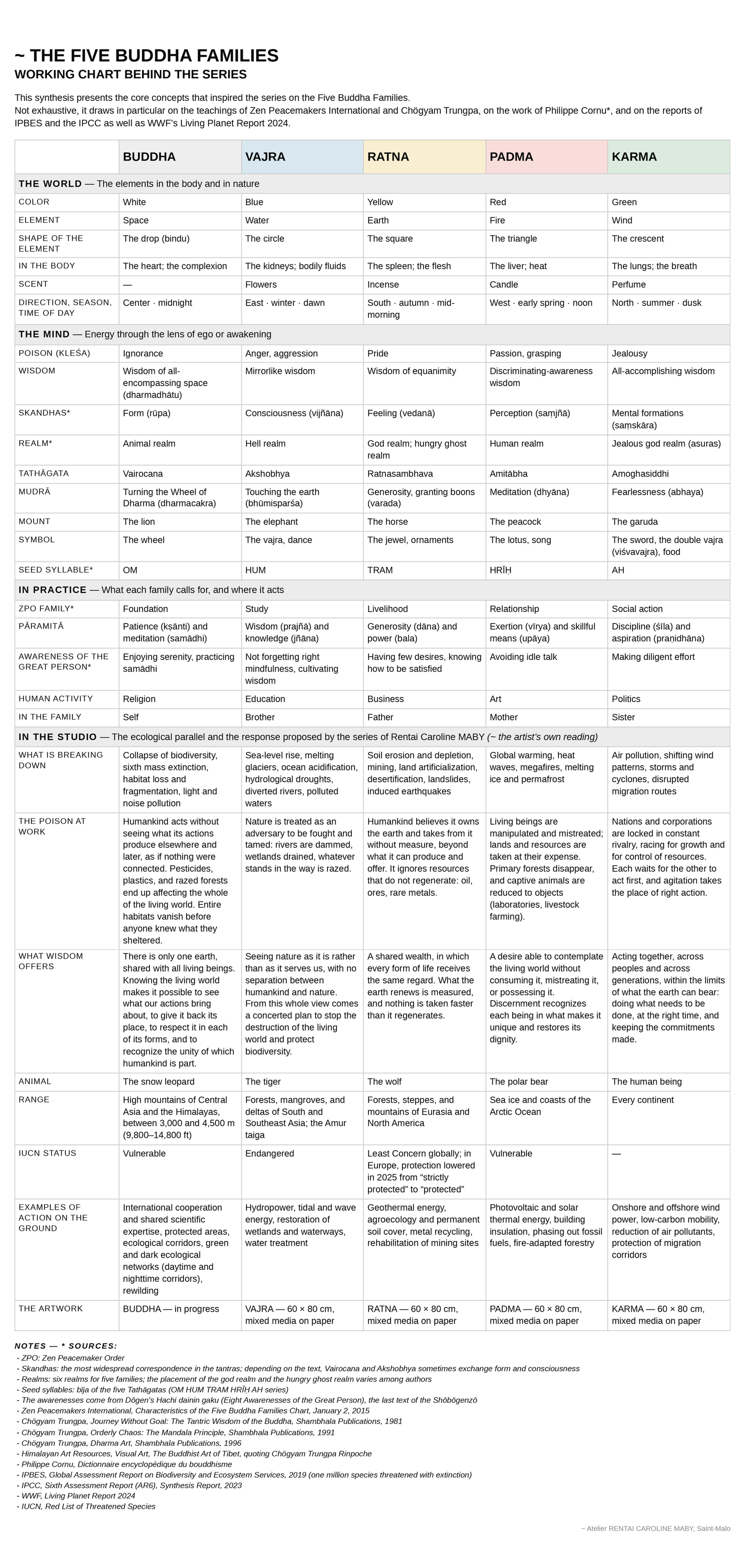
Each of these disasters can be linked to a color in my synthesis chart, and each corresponds both to a "responsible" passion and to a proposal for healing through awakened action.

On the neurotic level, the KARMA family manifests as jealousy, and on the awakened level as "all-accomplishing wisdom." It is the energy of the wind element, present everywhere and touching every corner of space. KARMA makes plain the place of humankind within this whole. Wind stops at no barrier, the air we pollute is the air we breathe, and the migrations that climate disruption sets in motion and displaces are as much those of birds and fish as our own.
Here, the animal is the human being: after the polar bear and the tiger, the human figure enters the series on the same footing as the others. Placing the human among the animals is a statement of position. As a vegetarian and antispeciesist, I had announced from the first part of this work (PADMA and VAJRA) the wish for a horizontal model, in which humans stand within nature rather than facing it, and a series of five animals from which the human was absent would have said exactly the opposite. Beyond this consideration, the choice of the fetus questions the future and the state of the planet we will leave to our children. It also evokes contemplation, creativity, negentropy.
KARMA questions ceaseless activity, the productivist haste that disturbs the winds, migrations, and the air we breathe. Its wisdom, that of accomplished action, answers with action attuned to what the rhythm of the earth can sustain. Stepping back, slowing down, and meditation are its conditions, because they make it possible to act at the right moment and with precision. Its symbol, the double vajra, represents the accomplishment of all actions.

With RATNA , yellow and earthy, I question pride. Seen from the side of ego, this energy comes with a constant anxiety of not being substantial enough, which is answered by accumulating and by building a tower of pride that nothing will ever question again. On the ecological level, it is the narcissistic self-assurance of humankind believing it owns the earth. It takes without measure, beyond what the earth can produce and offer, exhausts the soil, digs mines, consumes oil and rare metals without regard for the fact that they do not regenerate, and believes itself safe from droughts and earthquakes.
Seen from the side of awakening, the same energy gives access to an inexhaustible richness, and pride is transmuted into equanimity, in which all situations are seen with the same eye. It opens onto a shared wealth, in which every form of life is regarded with the same fraternal gaze and in which humankind measures what it takes by what the earth renews.
The animal of this work is the wolf. It seemed right for pride because, in Europe, it is the animal onto which the question of who has the right to occupy the land is projected. It is credited with intentions, counted, classified, shot, and its return is debated as one would debate a mining concession. At the same time, it is one of the few large predators whose return shows that an ecosystem is still holding its balance. Painting it within the sphere was a simple way of expressing what RATNA equanimity offers: a wealth that is shared, where the land does not belong to the one who exploits it.
WHAT THE FOUR ALREADY SAY TOGETHER

The four completed pieces already sketch the mandala, bringing together four passions and four elements. They resonate together and answer one another without overlapping.
PADMA, red and of fire. Here I question passion turned into greed, the kind that sets forests ablaze and melts the ice, while its discriminating wisdom would give us back a desire capable of contemplating the living world without consuming it. Its animal is the polar bear, borne by the lotus.
VAJRA, blue and of water. Here I look at anger and aversion, legible in diverted rivers, polluted waters, and retreating glaciers, while the mirrorlike wisdom it holds within would give us back the clarity to see nature as it is rather than as it serves us. Its animal is the tiger.
The four passions therefore do not call for the same remedies. Greed calls for a different discipline of desire, anger for a more penetrating vision, pride for a different relationship to ownership, jealousy for a different way of acting.
The mandala thus requires distinguishing the causes, and each family calls for its own responses on the ground.
The synthesis chart below sets them out in detail.
IN PROGRESS: BUDDHA
The fifth piece, the central one, will seal the mandala and give the series its full dimension. It belongs to the BUDDHA family, white and associated with space.
Its neurosis is ignorance, in the precise sense of torpor, insensitivity, and a refusal to know. Its wisdom is that of the dharmadhātu, the space that contains everything, without center or ego. It is the family most difficult to connect to the ecological side, because indifference produces no images: it burns nothing and digs nothing. It looks away and gives up.
On my notes pinned to the easel (studio photo above), two animals compete for the place: the snow leopard and the lynx. I have already chosen BUDDHA's ambassador and will soon present the finished work.
--
Sources and references
Zen Peacemakers International, Characteristics of the Five Buddha Families Chart: zenpeacemakers.org
Chögyam Trungpa, Dharma Art, Shambhala Publications, 1996
Himalayan Art Resources, Visual Art, The Buddhist Art of Tibet, quoting Chögyam Trungpa Rinpoche
Chögyam Trungpa Rinpoche, teachings on the mandala of the five families
Philippe Cornu, Encyclopedic Dictionary of Buddhism
Part One of this journal: Five Buddha Families — Padma and Vajra
IPBES, Global Assessment Report on Biodiversity and Ecosystem Services, 2019
WWF, Living Planet Report 2024


